
By the KMW Podiatry team. Last reviewed November 2026.
If you live with diabetes, your GP or diabetes educator has probably told you to “get your feet checked”. But what does a diabetes foot check involve, what should you bring, and how often do you need one? This guide explains what usually happens at a podiatry diabetes foot assessment at KMW Podiatry clinics across Adelaide and Gawler.
Why foot checks matter when you have diabetes
Over time, diabetes can affect the nerves and blood vessels in the feet. Reduced feeling (peripheral neuropathy) means a blister, a stone in a shoe or a cut from trimming nails may go unnoticed. Reduced circulation can mean small wounds heal more slowly. Diabetes Australia recommends that people with diabetes have their feet checked by their GP or a podiatrist at least once a year, and more often if they are found to be at higher risk.
A foot check does not treat diabetes itself. Its purpose is to find early changes so that you, your GP and your podiatrist can plan sensible prevention.
Before your appointment
It helps to bring:
- a list of your current medicines
- your most recent HbA1c result if you have it
- the shoes you wear most often, and any insoles or orthoses
- your GP Chronic Condition Management Plan (GPCCMP) referral, DVA card or NDIS details if you are using funding
Wear socks and trousers that are easy to roll up to the knee.
What happens during the assessment
Appointment length can vary, so ask our team how long to allow when you book. Your podiatrist will usually:
1. Ask about your health history. This includes how long you have had diabetes, any previous foot ulcers or amputations, smoking, kidney or eye problems, and any foot symptoms such as tingling, burning, cramping when walking or cold feet.
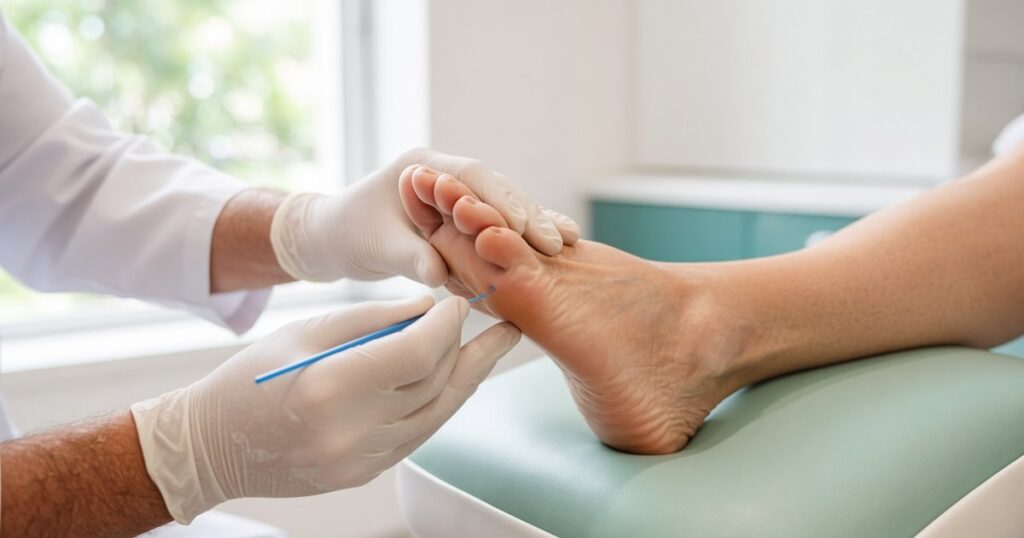
2. Check sensation. The most common test uses a monofilament, a fine nylon thread pressed gently against several points on the sole. You close your eyes and say when you feel it. Your podiatrist may also check vibration sense with a tuning fork and test reflexes.
3. Check circulation. This usually involves feeling the pulses on the top of the foot and behind the ankle bone, looking at skin colour and temperature, and checking how quickly colour returns to the toes. Some podiatrists also use a hand-held Doppler to listen to blood flow. If your podiatrist has concerns, they will write to your GP about further vascular testing.
4. Look at skin and nails. Your podiatrist looks for dry or cracked skin, corns and calluses, fungal infection, ingrown or thickened nails, and any breaks in the skin between the toes.
5. Look at foot shape and footwear. Bunions, clawed toes and high-pressure areas can increase risk when sensation is reduced. Your shoes will be checked for fit, wear patterns and anything rubbing inside.
Your foot risk rating
At the end of the assessment, your podiatrist will explain your results and give you a foot risk category. Australian guidelines (used by the RACGP and Diabetes Feet Australia) link each category to a suggested review interval:
- Very low risk (no loss of sensation or circulation): usually a yearly check
- Low risk (loss of sensation or reduced circulation): usually every six to 12 months
- Moderate risk (loss of sensation or reduced circulation plus a foot deformity, or both sensation and circulation affected): usually every three to six months
- High risk (loss of sensation or reduced circulation together with a previous foot ulcer, an amputation or end-stage kidney disease): usually every one to three months, often with ongoing care for skin, nails and footwear
Your podiatrist will tell you which category applies to you and may send a summary to your GP. If you are using a GP care plan referral, Medicare requires a written report to your GP after the first and last visits under that referral.
Treatment you may receive on the day
If needed, your podiatrist can also provide routine care in the same appointment, such as nail trimming, gentle reduction of callus or corns, and advice on moisturising and footwear. Anything that needs more time may be booked as a follow-up.
Looking after your feet between visits
Simple daily habits make a real difference:
- Check both feet every day, including between the toes. A mirror or a family member can help.
- Wash and dry your feet well, and moisturise the heels but not between the toes.
- Always wear shoes or slippers, including at home and at the beach. Adelaide’s hot footpaths and sand can burn feet with reduced sensation.
- Shake out your shoes before putting them on.
- Avoid hot water bottles and heat packs on your feet.
- Do not cut corns yourself or use medicated corn pads.
If your podiatrist suggests different footwear, our page on diabetic footwear explains what to look for.
When not to wait for your next check
Contact your GP or podiatrist promptly if you notice a new wound or blister that is not healing, redness, swelling or warmth, a change in foot shape, or pain in the calf when walking. If a wound is accompanied by fever, spreading redness or feeling unwell, seek urgent medical care.
Funding for diabetes foot checks
Many people with diabetes may be eligible for a GP Chronic Condition Management Plan, which can provide Medicare rebates for up to five eligible allied health services each calendar year (see our GP care plans page). DVA card holders, NDIS participants (where podiatry is in the plan) and Support at Home recipients may also be able to use their funding. Private health insurance extras may cover part of the fee. Ask our team which option suits you when you book.
Frequently asked questions
How often should I have a diabetes foot check?
At least once a year, and more often if your podiatrist finds you are at low, moderate or high risk.
Does a diabetes foot check hurt?
The tests themselves are generally painless. The monofilament and tuning fork are pressed lightly on the skin, and pulses are checked by touch.
Do I need a referral?
Not for a private appointment. You do need a GP referral if you want to claim a Medicare rebate under a GP Chronic Condition Management Plan, or to use DVA funding.
Can my GP do the foot check instead?
Yes, your GP or practice nurse can do a foot check. Many people also see a podiatrist, especially for nail, skin or footwear care.
Book a diabetes foot check
KMW Podiatry has 22 clinics across Adelaide and Gawler, many located within medical practices, plus home visits for people who find it hard to travel. See our diabetic foot care services, find your nearest clinic or book online. You can also call 1800 962 113.
This article is general information only and is not medical advice. Please speak with your GP or podiatrist about your own health. KMW Podiatry’s podiatrists are registered with the Podiatry Board of Australia through Ahpra.