
By the KMW Podiatry team. Last reviewed November 2026.
Nurses, retail and hospitality staff, teachers, hairdressers, warehouse workers and tradies can spend most of a shift on their feet. By the end of the day, it is common to feel aching arches, sore heels, tired legs or swollen ankles. While some tiredness is expected, ongoing pain is worth paying attention to. This guide covers practical footwear and self-care tips for standing jobs, and when to get your feet checked.
Why standing all day is hard on feet
Standing still can be more tiring than walking. When you stand in one position, the same muscles stay working, pressure stays on the same areas of the feet, and blood can pool in the lower legs. Hard floors such as concrete and tiles add to the load. Over time, this can contribute to:
- arch and heel pain, including plantar fasciitis
- pain in the ball of the foot
- corns and calluses
- swollen feet and ankles
- tired, aching legs and knees
Choosing work shoes
Your workplace may have rules about safety footwear, slip resistance or uniforms, so start there. Within those rules, look for:
A good fit
Allow about a thumb’s width of space beyond your longest toe, enough width for your forefoot, and a heel that does not slip. Healthdirect recommends shoes that fit well and suit the activity you are doing. Shop later in the day, when feet are slightly larger, and wear the socks you use at work.
Support and stability
A firm heel counter, a sole that bends at the ball of the foot rather than the middle, and a secure fastening help keep the foot stable through a long shift.
Cushioning
Some cushioning helps on hard floors, but a very soft shoe can feel unstable. Many people find a moderately cushioned shoe comfortable for long periods.
A sensible heel height
A low heel, often a small raise of a couple of centimetres rather than completely flat or high, tends to be comfortable for long periods of standing. If high heels are part of your role, see if lower options are allowed.
Removable insoles
A removable insole gives you the option of adding an insole or orthosis if needed later.
Safety boots and steel caps
Safety boots should fit the width and depth of your foot as well as the length, so the toe cap does not press on your toes. Break in new boots gradually, choose cushioned socks, and replace insoles when they flatten. If boots are causing pain or rubbing, talk to your employer and a podiatrist about options.
Small changes during the shift
- Shift your weight and move around regularly rather than standing still.
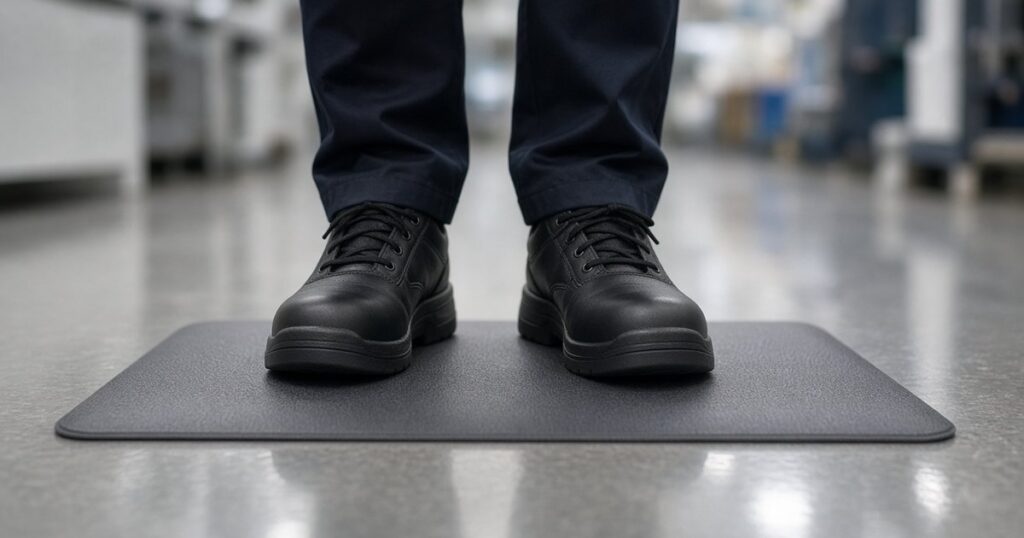
- Use an anti-fatigue mat at fixed workstations if one is available.
- Do simple calf raises and ankle circles during breaks.
- Sit when you can on breaks, and elevate your feet for a few minutes.
- Stay hydrated.
Socks matter too
Choose socks that fit well without tight bands, and materials that manage sweat. Change them if your feet get damp. Some people find graduated compression socks help with tired, swollen legs, but check with your GP first if you have diabetes, circulation problems or any heart condition.
After work: recovery
- Take your work shoes off and let them air out. Rotating between two pairs lets each pair dry fully.
- Gently stretch your calves and roll the arch of your foot over a ball or bottle.
- Elevate your legs for a short time if your ankles are swollen.
- Check your feet for blisters, corns or rubbing spots.
Do insoles or orthotics help?
Off-the-shelf cushioning insoles can add comfort for some people. If you have a specific problem, such as heel pain, forefoot pain or high-pressure areas, a podiatrist can assess whether a prefabricated or custom orthosis may help as part of a broader plan. Our shoe fitting advice page has more general tips.
When to see a podiatrist
Consider booking an appointment if:
- foot or heel pain lasts more than a couple of weeks
- pain is worst with your first steps in the morning or after sitting
- you have numbness, tingling or burning in your feet
- corns, calluses or blisters keep coming back
- swelling is new, one-sided or painful (see your GP promptly for this)
- pain is affecting your ability to do your job
A podiatrist will look at your feet, how you walk, your work footwear and the demands of your role, and discuss options such as footwear changes, exercises and insoles. Learn more about foot pain treatment.
Frequently asked questions
What shoes are good for standing all day?
Shoes that fit well, with a firm heel counter, moderate cushioning, a low heel and a secure fastening, suit many people. Your workplace’s safety and slip-resistance rules also matter.
Are anti-fatigue mats worth it?
Many people find them more comfortable than standing on hard floors at a fixed workstation. Moving regularly is still important.
Should I wear compression socks at work?
Some people find graduated compression socks help tired, swollen legs. Check with your GP first if you have diabetes, circulation problems or a heart condition.
Why do my feet hurt more at the end of the week?
Fatigue can build up over consecutive shifts, especially on hard floors or in worn shoes. Rotating shoes, stretching and resting your feet between shifts can help. Ongoing pain should be assessed.
Book a foot assessment
KMW Podiatry has 22 clinics across Adelaide and Gawler. Find a clinic near your home or work. Book online or call 1800 962 113.
This article is general information only and is not medical advice. Please see your GP or podiatrist about your own situation. KMW Podiatry’s podiatrists are registered with the Podiatry Board of Australia through Ahpra.